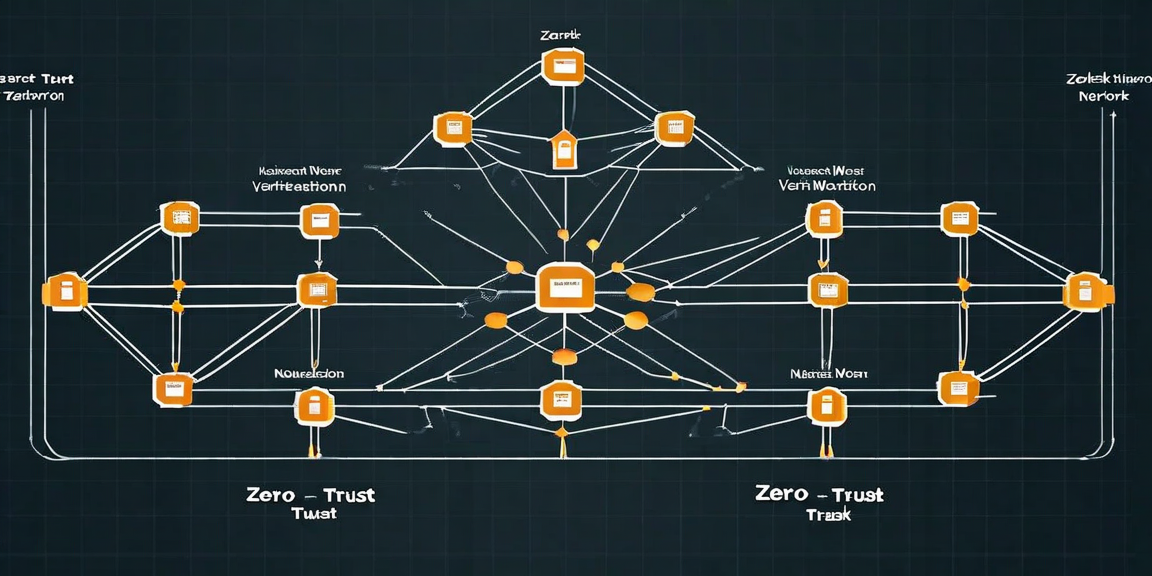
Zero-trust has become the most discussed concept in enterprise security architecture over the past several years. Unfortunately, it has also become one of the most misunderstood and inconsistently implemented. Organizations that declare themselves "zero-trust" after deploying a new VPN replacement or adding multi-factor authentication to their primary application are not operating zero-trust architectures — they have applied zero-trust branding to incremental improvements in their existing perimeter-centric model.
True zero-trust is a fundamental architectural philosophy that eliminates the assumption of trust based on network location and replaces it with continuous, context-aware verification of every access request, from every entity, to every resource, every time. Implementing it from scratch requires re-examining virtually every assumption that underlies conventional enterprise security architecture.
The Core Principles of Zero-Trust
Zero-trust architecture is built on three core principles that, together, define a coherent and distinctly different security model from the perimeter-centric architecture it replaces.
The first principle is "never trust, always verify." In a conventional perimeter model, being inside the network perimeter grants implicit trust. Entities on the internal network can reach internal resources with minimal additional authentication requirements, because the perimeter is assumed to have already filtered out threats. Zero-trust eliminates this assumption: every access request must be authenticated and authorized regardless of whether it originates from inside or outside a traditional network perimeter.
The second principle is least-privilege access. Every entity — user, device, application, or service — should have access to exactly the resources required to perform its current function and nothing more. Broad permissions granted for convenience create lateral movement pathways that attackers exploit. Least-privilege access enforced at every layer — network, application, data — dramatically reduces the blast radius of any given compromise.
The third principle is assume breach. Zero-trust architecture is designed with the assumption that adversaries may already be inside the environment, or may breach it at any time. This means monitoring all traffic including internal traffic, implementing micro-segmentation to limit lateral movement, encrypting data in transit at all points including inside the perimeter, and treating every access attempt as potentially adversarial until verified.
Identity as the New Control Plane
In a zero-trust architecture, identity is the primary control plane through which all access decisions are made. The conventional control plane — network location — is replaced by a system that continuously evaluates who is making a request, from what device, in what context, and what they are requesting access to.
Strong identity verification requires more than username and password authentication. Multi-factor authentication (MFA) is a prerequisite, but not sufficient on its own. Phishing-resistant MFA mechanisms — hardware security keys and passkeys rather than SMS or authenticator app codes — are increasingly important as adversaries have become sophisticated at real-time phishing attacks that capture one-time codes.
Device health is an essential component of identity-based access decisions. A user presenting valid credentials from a device with outdated operating system software, missing endpoint security controls, or unknown enrollment status represents higher risk than the same user on a fully managed, compliant device. Zero-trust access policies should incorporate device compliance status in access decisions, denying or restricting access from devices that fail health checks even when user credentials are valid.
Continuous authentication is the zero-trust evolution beyond point-in-time login. Rather than evaluating identity once at login and granting a session that persists until logout, continuous authentication systems monitor behavioral signals throughout the session — typing patterns, navigation patterns, geolocation, device posture changes — and can challenge or terminate the session if signals suggest the authenticated user is no longer the person originally authenticated.
Network Architecture: Micro-segmentation and ZTNA
Network architecture in a zero-trust model shifts from flat or coarsely segmented networks to micro-segmented architectures where individual workloads, applications, and data stores are isolated from each other by default, with access permitted only through explicitly defined policies.
Micro-segmentation applies the principle of least-privilege to network connectivity. In a conventional flat network, a compromised endpoint can typically reach most other endpoints, databases, and services on the same network segment. In a micro-segmented architecture, network policies restrict communication to only the specific flows required for legitimate operations — a web server can reach its application database on the required port, but cannot reach the finance system's database, the backup server, or other workloads it has no legitimate reason to communicate with.
Zero Trust Network Access (ZTNA) replaces VPN-based remote access with a model where users connect directly to specific authorized applications rather than connecting to the corporate network and then accessing applications through it. ZTNA brokers evaluate the full context of each connection attempt — user identity, device health, location, time of day — and provide access only to the specific applications the policy allows, with no network-level visibility to other resources.
East-west traffic inspection extends security monitoring to lateral traffic within the environment, which conventional architectures largely leave unmonitored. Zero-trust requires treating traffic between internal workloads with the same scrutiny as traffic entering from the internet, because lateral movement by an attacker who has established an initial foothold looks exactly like internal network traffic.
Data-Centric Security Controls
Zero-trust architecture extends the principle of continuous verification to data access. Data classification, combined with policy enforcement at the data layer, ensures that sensitive data cannot be accessed by unauthorized entities even if network and application controls are bypassed.
Data classification provides the foundation by labeling data assets according to their sensitivity and applicable access policies. Classification should be automated to the extent possible — manual classification programs rarely achieve complete coverage — using machine learning models that can identify sensitive data types (PII, financial records, intellectual property, credentials) in documents, databases, and cloud storage.
Encryption at rest and in transit is non-negotiable in zero-trust environments. Data that is encrypted even when accessed through authorized channels cannot be exfiltrated in usable form if the encryption keys are properly managed. Key management — ensuring that access to encryption keys is subject to the same zero-trust access controls as access to the data itself — is a critical implementation detail that is often underemphasized.
Implementing Zero-Trust: A Practical Roadmap
Organizations beginning a zero-trust implementation journey should resist the temptation to attempt a complete simultaneous transformation. Zero-trust is best implemented incrementally, with each phase building on the previous and delivering measurable security improvement at each stage.
Phase 1 focuses on identity foundation: deploying phishing-resistant MFA across all applications, implementing a unified identity provider, establishing device management and health checking, and building the directory infrastructure that will serve as the policy decision point for access requests.
Phase 2 focuses on application access: deploying ZTNA to replace VPN for remote access, implementing single sign-on (SSO) across applications, and establishing the monitoring infrastructure for application access patterns.
Phase 3 addresses network segmentation: beginning micro-segmentation of critical workloads and data stores, implementing network monitoring for east-west traffic, and deploying network access controls that enforce the segmentation policy.
Phase 4 extends to data: completing data classification, implementing encryption at rest with proper key management, and deploying data access monitoring and policy enforcement at the data layer.
Each phase should be accompanied by implementation of monitoring for the controls deployed in that phase. Zero-trust controls without visibility into whether they are working correctly create a false sense of security.
Key Takeaways
- Zero-trust is an architectural philosophy, not a product — implementing it requires re-examining fundamental assumptions about how access is granted and monitored across the entire environment.
- The three core principles — never trust/always verify, least privilege, and assume breach — must be applied consistently across identity, network, application, and data layers.
- Identity is the primary control plane in zero-trust, replacing network location as the basis for access decisions and requiring strong, continuous authentication mechanisms.
- Micro-segmentation and ZTNA eliminate the lateral movement pathways that make conventional breaches so devastating, limiting the blast radius of any single compromise.
- Data-centric controls including classification, encryption, and access monitoring extend zero-trust principles to the ultimate target of most attacks — the data itself.
- Incremental implementation by phase is more effective than attempting simultaneous transformation, with each phase delivering measurable security improvement.
Conclusion
Zero-trust architecture is not a destination that organizations arrive at completely — it is a continuous journey of applying the principles of least privilege, continuous verification, and assumed breach more comprehensively across the environment over time. Organizations that begin this journey and make measurable progress on each phase will find their security posture improving continuously even before the transformation is complete.
The perimeter-centric security model that zero-trust replaces was designed for a world where the network boundary was meaningful, where workloads lived in physical data centers, and where remote access was exceptional rather than routine. That world no longer exists. The security model must evolve to match the environment it protects.
Learn how AIFox AI integrates with zero-trust architectures to provide continuous behavioral monitoring and threat detection within environments designed on zero-trust principles.
David Nakamura is CTO at AIFox AI and a former principal engineer at two leading cloud security companies. He leads the development of AIFox AI's core detection and response platform.