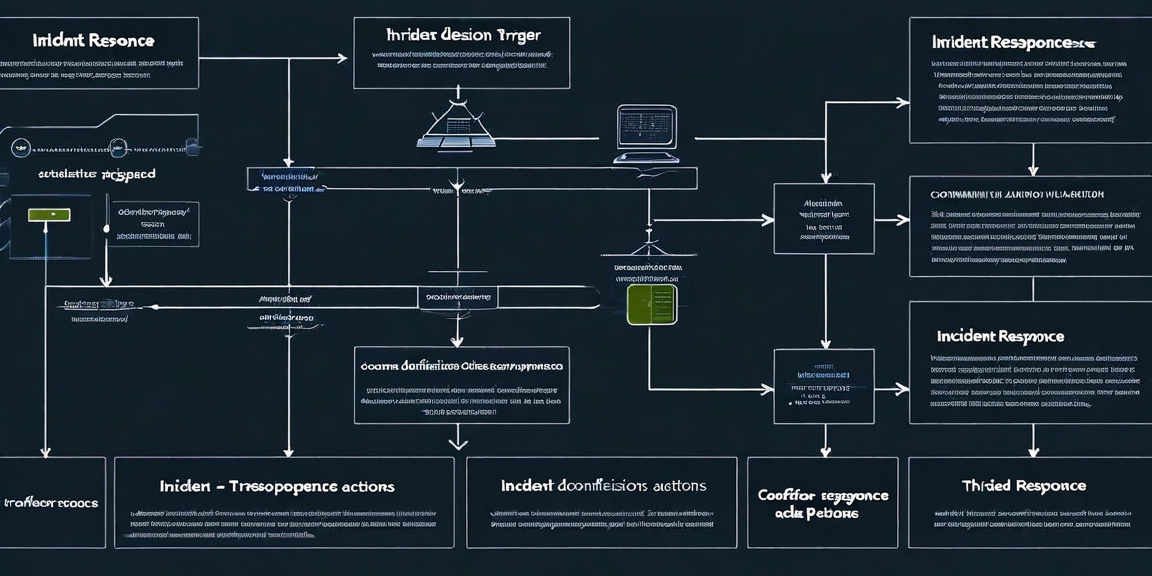
Modern cyber attacks move at machine speed. The time between initial compromise and significant damage — credential exfiltration, ransomware deployment, data theft — has compressed from days to hours to, in many of the most devastating recent incidents, minutes. Human-speed security operations, no matter how skilled, cannot match the response time required to contain threats before they cause serious harm.
This is the compelling case for automated incident response. When a detection fires with high confidence, automated systems can isolate affected endpoints, revoke compromised credentials, block malicious network connections, and snapshot affected systems for forensic analysis — all within seconds of detection, before human analysts have finished reading the alert. The speed advantage over manual response is not marginal; in active ransomware scenarios, it can mean the difference between a contained incident and a company-destroying catastrophe.
But automation operates on rules, and rules are wrong sometimes. An automated response that incorrectly isolates a production database server, revokes credentials for a legitimate VIP user, or blocks network connections to a critical business partner can cause operational damage that rivals or exceeds the threat it was intended to stop. The speed-accuracy tension in automated incident response is real and must be managed with care.
The Case for Speed: Why Manual Response Is No Longer Sufficient
The data on attack speed makes an unambiguous case for automation. In well-documented ransomware incidents, the time from initial execution to full domain encryption averages 45 minutes for the most aggressive variants. At the time of detection — which occurs, on average, more than four hours after initial execution even in well-monitored environments — the majority of damage is often already done if response depends on human action.
Credential attacks move even faster. A compromised administrative credential used for cloud access can enumerate permissions, identify valuable targets, exfiltrate data, and establish persistence in under ten minutes. The manual workflow of receiving an alert, investigating it, reaching a disposition decision, and executing a response action typically takes 20 to 40 minutes at best — far too slow to prevent significant damage in these scenarios.
Security teams are also not available at machine speed around the clock. Attacks frequently commence outside business hours specifically because adversaries know that response capability is degraded during nights and weekends. Automated response systems operate at full capability 24/7, removing the staffing advantage that adversaries deliberately exploit.
The compounding effect matters at scale. An organization that can automate containment for the 80% of incidents that fall into well-understood categories — known malware families, compromised credential patterns, cloud misconfiguration exploits — allows its human analysts to focus 100% of their attention on the novel, complex incidents that genuinely require human judgment. The quality of human response to hard problems improves dramatically when humans are not simultaneously trying to manually handle routine incidents.
The Risk of Getting It Wrong
Automated response errors fall into two categories with very different consequences: under-response (failing to contain a genuine threat) and over-response (taking containment action against a false positive).
Under-response is the failure mode that automation is designed to prevent, but it can still occur when detection confidence thresholds are set too high, requiring too much evidence before triggering automated action. An organization that only automates response for detections with 99%+ confidence will leave significant attack scenarios where the evidence accumulates more gradually — initial access followed by slow lateral movement, for example — outside the automated response envelope.
Over-response is often more immediately visible and damaging to organizational trust in automation. When automated response isolates the wrong endpoint, it disrupts legitimate operations. When it revokes the wrong credentials, it locks out users who need access to perform their work. When it blocks network connections to a misidentified malicious destination, it may interrupt legitimate business-critical communication. Each over-response event erodes confidence in the automated system and creates organizational pressure to reduce automation scope.
The consequences of over-response are not symmetrical across environments. Isolating an analyst's workstation causes inconvenience. Isolating a production payment processing server during peak transaction hours causes immediate, measurable financial damage. Automated response playbooks must account for asset criticality in their confidence threshold calibrations.
A Framework for Calibrating Automation Scope
Rather than treating automation as a binary on/off decision, effective automated response programs use a tiered framework that matches automation scope to confidence level and asset criticality.
Tier 1 automation — immediate, no-human-required — should be reserved for high-confidence detections against non-critical assets where the potential harm from over-response is low and the potential harm from delay is high. Known malware execution on an analyst workstation is a canonical example: the confidence is high, the containment action (isolating the workstation) is reversible, and the speed advantage of immediate isolation is significant.
Tier 2 automation — immediate execution with immediate human notification — handles higher-confidence detections where the containment action is reversible but the potential for operational impact is meaningful. Account lockout for a suspected compromised credential falls into this category: the action can be taken immediately to prevent ongoing credential abuse, but a human is notified simultaneously to verify the detection and quickly restore access if it was a false positive.
Tier 3 automation — pre-staged action pending human approval — handles high-impact containment actions where the speed advantage of automation is less critical than the accuracy advantage of human verification. Isolating a production database server, revoking access for a senior executive, or blocking a major business partner IP range should be staged for immediate execution pending a human approval that can typically be obtained within minutes through mobile notification.
Tier 4 — human-executed with AI-assisted investigation — handles novel threats where the confidence and context required for automation are not yet established, and where a human analyst needs to build the picture before taking action.
Detection Quality as the Prerequisite for Automation
The prerequisite for safe, effective automation is detection quality. Automation that acts on high-false-positive detections will cause operational harm at scale. Every percentage point of false positive rate in a detection that triggers automated isolation of endpoints, for example, translates directly into automated operational disruptions.
This means that organizations should not automate response before they have high-confidence detections that justify automation. Building detection capability first — investing in behavioral AI, tuning alert quality, reducing false positive rates — creates the foundation on which safe automation can be built. Organizations that automate response prematurely, before their detection quality justifies it, will experience the operational disruptions of over-response at scale and often end up disabling automation entirely, losing the speed advantage that justified the investment.
The automation scope should expand incrementally as detection confidence is validated. Starting with the detection categories with the highest historical true positive rates and the lowest-criticality assets allows organizations to build automation muscle, validate playbook logic, and develop analyst confidence in automated systems before expanding to higher-stakes scenarios.
Human Oversight in Automated Response Systems
Automated response systems that operate without meaningful human oversight create accountability and safety risks that organizations often underappreciate until something goes wrong. A fully autonomous response system that cannot be audited, overridden, or stopped by human operators is not a security control — it is a liability.
Effective automated response architectures preserve human oversight at multiple levels. Real-time visibility into all automated actions taken, in a searchable and auditable log, allows security leadership to understand exactly what the system is doing and identify patterns of over-response before they cause significant harm. Override capabilities allow authorized humans to stop, pause, or reverse automated response actions at any point. Configurable kill switches allow rapid disabling of specific playbooks if operational impact warrants it.
Regular playbook review and validation ensures that automation logic remains accurate as the environment evolves. Asset criticality classifications change as infrastructure evolves. Detection confidence characteristics change as models are updated. Playbook logic that was appropriate when first deployed may need recalibration as the environment beneath it changes.
Key Takeaways
- Modern attacks move faster than human-speed response can contain — automated response is increasingly necessary to prevent serious damage in active attack scenarios.
- Over-response errors can cause immediate operational harm that damages organizational trust in automation and may exceed the impact of the threat being contained.
- A tiered automation framework calibrated to confidence level and asset criticality provides speed where the risk profile supports it and human oversight where it doesn't.
- Detection quality is the prerequisite for safe automation — organizations should not automate response before their detection false positive rates justify it.
- Human oversight through real-time visibility, override capabilities, and regular playbook review is essential for responsible automated response operation.
- Automation scope should expand incrementally, starting with high-confidence detections against non-critical assets and expanding as confidence in playbook logic is validated.
Conclusion
The speed-accuracy tension in automated incident response is genuine, but it is navigable. Organizations that approach automation with a principled framework — tiered by confidence and asset criticality, built on high-quality detection, and operated with meaningful human oversight — can capture the speed advantages that automation provides while managing the accuracy risks that it creates.
The alternative to thoughtful automation is not safety — it is accepting that manual response will continue to lose the race against machine-speed attacks. The question is not whether to automate, but how to automate in a way that makes the organization more secure, not less.
Explore AIFox AI's automated response capabilities and see how our tiered playbook system delivers machine-speed containment with the accuracy controls your operations require.
Sarah Mitchell is CEO and co-founder of AIFox AI. She previously led cloud security product strategy at a Fortune 100 technology company and holds a master's degree in computer science from MIT.